The Journey of Peiya!
- junlachaktophat
- Mar 4, 2025
- 3 min read

Updated: Mar 29
GitLab Repository: Click Here
Download Now: Click Here
Game Overview
The Journey of Peiya is a third-person adventure game where players take on the role of Peiya, a young woman who embarks on a journey to become a true fisherman. Inspired by her friend, she must travel to Khanom Lake, catch fish from a specific list, and prove her skills under a time limit.
The game combines physics-based fishing mechanics with AI-driven fish behavior, requiring players to carefully time their casts and react to fish movement patterns. Players will also need to navigate obstacles while fishing, adding an extra layer of challenge.
Story & Gameplay
A young woman named Peiya has grown tired of city life. One day, she receives a letter from a friend saying:"Long time no see. I'm currently in Jelly Village. There's a lot to do here. I'm a snack fisherman now. If you are interested, you can come visit me."
Curious about this new way of life, Peiya decides to quit her job at Dessert City Inc. and travel to Jelly Village to meet her friend. Excited about becoming a fisherman, she tells her friend about her plan.
Her friend laughs and replies: "Sure, but you need to train at the lake first!" Handing Peiya a list of fish to catch, she sets off to Khanom Lake, determined to complete her fishing journey.
How To Play
Move using W, A, S, D, and left-click to cast a fishing rod.
Players need to collect over 50 points within a time limit.
Each area has obstacles that hinder the players. Players must be careful not to be swept into the water by these obstacles. If a player falls into the water, the player will lose the allotted time.
Development Team
Kanyavee Sematong
Junlacak Juntaslip
Theeramate Saeba
My Role
Gameplay Programmer
Core Mechanic that I created
Fishing Mechanics
This project creates a fishing system that combines physics, logic, and object interaction. The casting system functions like a gun firing bullets, but instead of bullets, fishing bait is generated. When the player left-clicks, the bait is propelled forward via a rigid body using the "AddForce"command. Finally, a cooldown system requires a 5-second delay to prevent the player from casting too rapidly.

The bass string incorporates Unity's physics system called Hinge Joint, connecting the hook and the fishing line. This physics simulates hinge rotation or movement, allowing the fishing line to swing back and forth according to the character's movement.
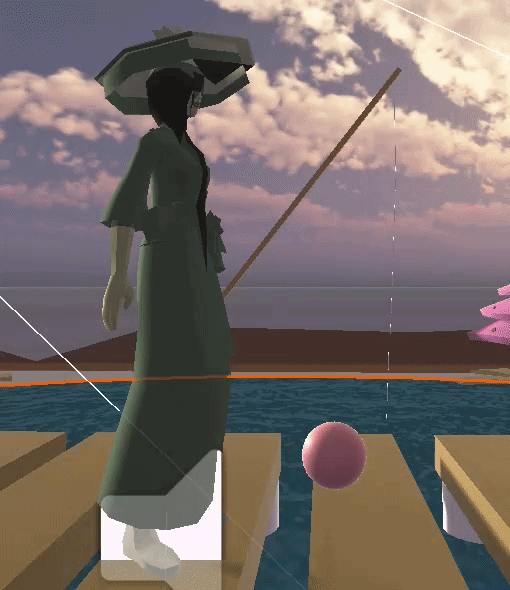
Nevertheless, there's a Collision Detection system that uses the OnCollisionEnter function to detect whether an object is a valid tag and then destroys it, simulating a successful fish catch.

Fish AI Behavior
The AI system for the fish in this project is designed with an A-star movement pattern, meaning that waypoints are defined to make it appear as if the fish is swimming in a specific direction. The fish will move along the set waypoints, and when they are close to a point (less than 1 meter away), the system will immediately change its target to the next point.

Each AI fish will respond differently to bait depending on its type: easy_fish calls the "AddPointeasy" function, medium_fish calls the "AddPointmedium" function, and finally hard_fish calls the "AddPointhard" function. The score will depend on how difficult the fish is to catch.

Obstacles Environment
The obstacle system is designed to increase the challenge for players in the game. The pendulum is the first obstacle players will see. It uses physics-based movement (hinge joint) to create an obstacle that requires players to time their movements to avoid it. These objects have a box collider to detect collisions with the player. If a player walks into or is hit by these objects, the player will be knocked back.

The ice surface system utilizes Unity's Physic Material to modify character movement behavior for a smoother experience. This is achieved by setting the dynamic friction value very low, so that objects moving on this surface flow fluidly and don't suddenly stop when the player disables movement.

Tools Used:
Unity 2021.2+
GitLab
SmartGit
GitLab Repository: Click Here
Download Now: Click Here

Comments